
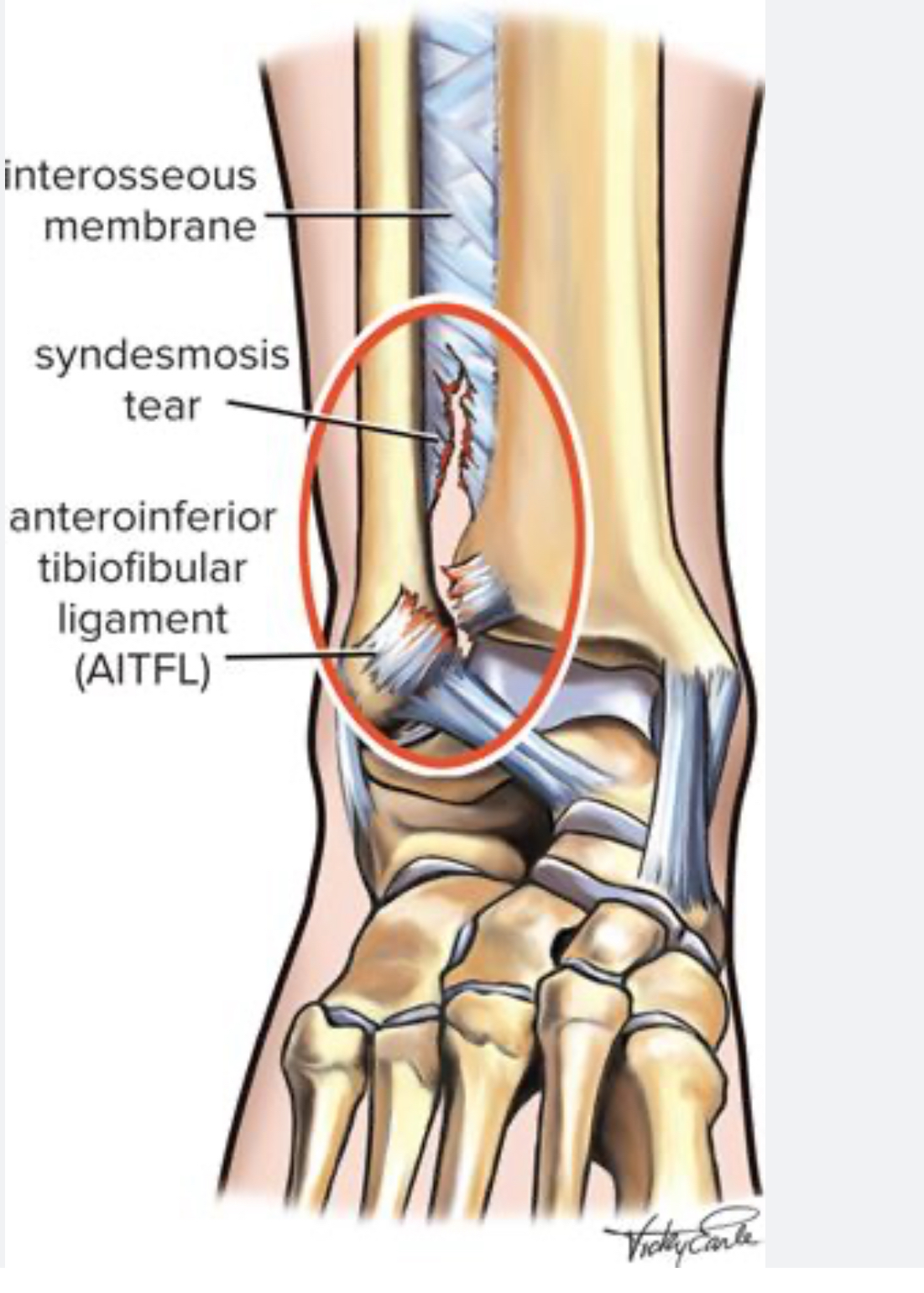
The syndesmosis refers to a group of passive structures that form the connection of the tibia and fibula (the two long bones of the lower leg) just above the ankle joint. The syndesmosis consists of ligaments and an interosseous membrane that play a key role in providing stability to the ankle joint when playing sport, walking, running and landing.
A syndesmosis injury typically occurs when the ankle is forced into dorsiflexion and external rotation (up and outwards) under high load/force. This movement can occur in footy during a tackle, netball when changing direction or even basketball if a player were to fall onto your ankle.
sIGNS aND Symptoms
Pain is typically experienced above the ankle and it may be difficult or uncomfortable to weight bear through your ankle.
Symptoms may include:
- Pain and swelling above the ankle joint
- Tenderness and pain to pressure above the ankle joint
- Instability or a feeling of “giving way”
- Inability to weight bear or push off during walking
How Are Syndesmosis Injuries Diagnosed?
Syndesmosis injuries can be diagnosed through specific clinical tests by a Physiotherapist or can be confirmed via imaging such as an X-ray, ultrasound, or MRI whereby the extent of syndesmotic damage can be identified.
Causes
- Trauma
- Landing with your ankle in an awkward position
- Predisposing factors
- Ankle ligament instability
- History of ankle sprains
Management and Rehabilitation
The treatment approach depends on the severity of the injury.
1. Initial/Acute Management
- Rest, ice, compression, and elevation (RICE) to control swelling
- Immobilisation in a moonboot if walking is painful
- Crutches to offload your injured ankle if needed.
2. Rehabilitation Phase
A structured physiotherapy program will focus on:
- Restoring range of motion while protecting healing ligaments
- Strengthening exercises for the calf, peroneal muscles and surrounding active stabilisers of your ankle.
- Proprioception and balance training to retrain ankle stability, control and confidence
- Gradual return to sport-specific drills under supervision
3. Surgical Consideration
For severe injuries involving instability or widening of the syndesmosis, surgery may be required to stabilise the joint. Physiotherapy is still crucial afterwards to guide safe recovery and return to activity.
Recovery timeline
Syndesmosis injuries typically take longer to heal than standard ankle sprains. The timeframes often depend on the severity of the injury.
- Mild injuries such as ligament sprains may recover within 6–8 weeks
- Moderate to severe injuries can take 3 months or more, especially if surgery is involved
Returning to sport
Safe return to sport is based on:
- Pain-free running, jumping, and cutting movements
- Demonstrated ankle strength and endurance
- Passing functional performance tests with your physiotherapist
If you have a high-grade ankle injury, contact our team to assist you in returning to getting back to what you love. Phone 9716 2250 or online via our website https://whittleseaphysiotherapy.com.au/